
Why it matters
It gets done on site, not later
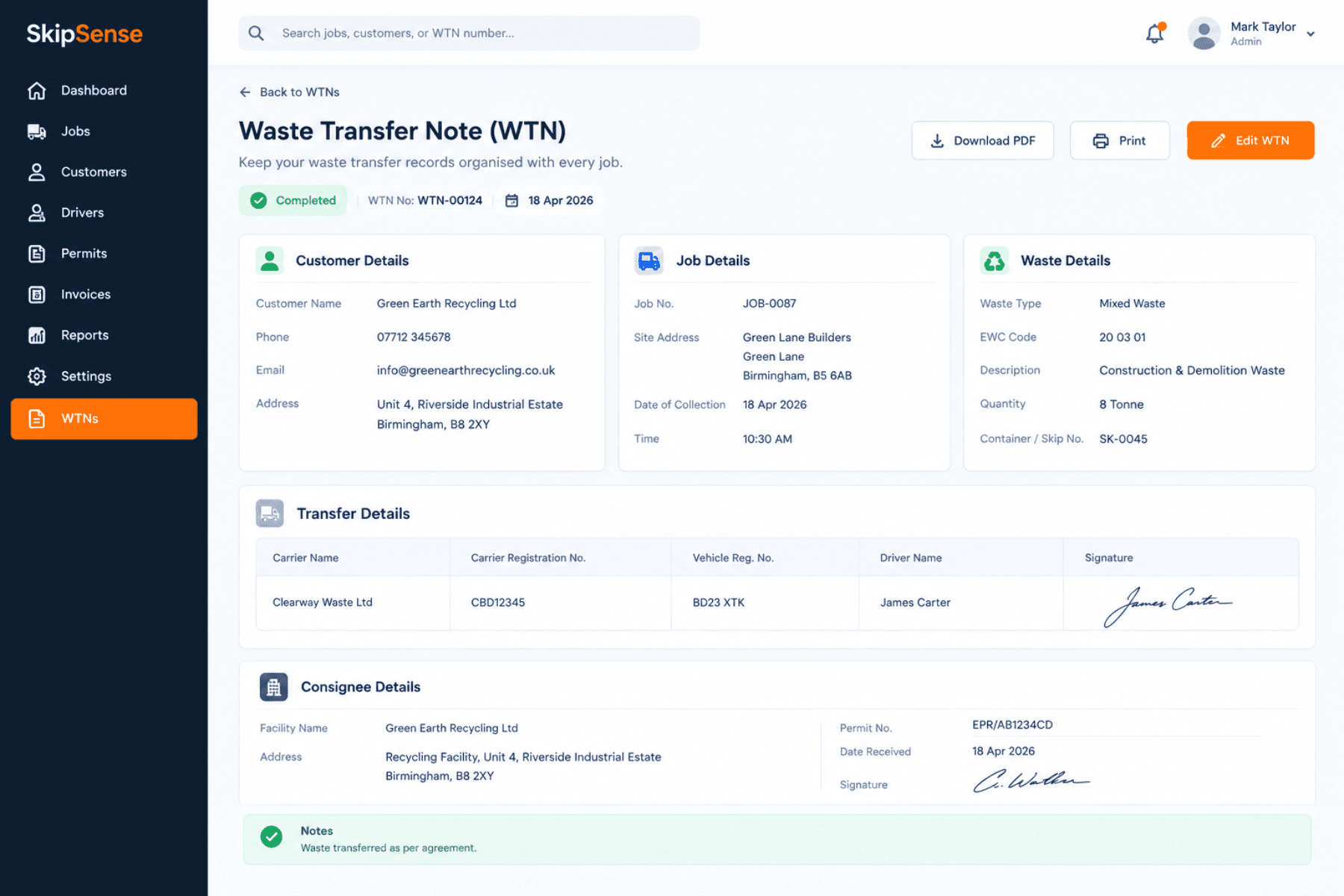
The note is completed as part of the job, on the driver's phone, while the lorry is still there. Not written on a docket that has to survive a week in a cab.
The codes are on it
EWC classification codes are part of the record rather than something written as "builders waste" and sorted out later — or never.
You can find it in seconds
Every note is stored and searchable for two years. When a customer, or anyone else, asks for a specific movement, it's a search rather than a filing cabinet.
The customer gets their copy automatically
The note is emailed to the customer when the job's done. No handing over a smudged carbon copy, no chasing.
How it works
1. The job carries the waste details
Skip size, waste type and the customer's details come from the booking, so most of the note is already filled in before the driver arrives.
2. The driver completes it on site
Classification, any notes, and a signature — captured on the phone at the point the waste actually changes hands.
3. It's generated and sent
The note is produced and emailed to the customer automatically.
4. It's stored and searchable
Two years of records, searchable by customer, date, job or reference — rather than by which filing cabinet.
About the 2026 changes
You have probably heard that waste tracking in the UK is going digital, and that there's a deadline in October 2026.
Here's the honest position, because this is an area where a lot of software marketing is currently overstating things:
SkipSense produces digital waste transfer notes. Your records exist as structured digital data with classification codes, signatures and timestamps, rather than as handwriting on a carbon copy.
SkipSense does not currently submit to the Environment Agency's Digital Waste Tracking service. That is a separate national system with its own registration and submission process, and integrating with it is on our roadmap rather than in the product today.
What having digital records does do is put you in a much better position when your deadline arrives, whichever route you take to submit — because the underlying data already exists in a structured form instead of on paper.
If you want to understand what's actually changing, when, and who it applies to first, we've written a full guide:
Read: Digital Waste Tracking — what UK skip hire firms need to know →
Related features
- Driver dashboard — where the note actually gets completed
- Bookings & dispatch — where the waste details come from
- Invoicing & Reports — the invoice and payment record for the same job
Common questions
Does this replace paper waste transfer notes?
It replaces the process of writing them by hand. The note is created digitally, sent to the customer digitally, and stored digitally.
Does it make me compliant with digital waste tracking?
No — and be wary of anyone claiming their software does that for you today. The Environment Agency's service is a separate national system you submit to. What digital records do is make whichever submission route you choose far easier than working from paper. Full explanation in our guide.
How long are notes kept?
Two years, searchable.
What if the customer isn't there to sign?
If the customer isn't available to sign, the driver can upload a photo as proof of delivery or collection and record the reason for the missing signature. The job details will be saved digitally in SkipSense.
Can I get a copy of an old note?
Yes — search by customer, date or reference and it's there.